
Sep 29, 2023 | Blog, Express Entry, Immigration, In the News, Permanent Residency, Why you need an immigration specialist
Canada’s Immigration, Refugees, and Citizenship Canada (IRCC) releases an annual report on Express Entry, with the latest one being the 2022 version.
Understanding Express Entry
Express Entry is an innovative application management system that oversees the Federal Skilled Worker Program, the Canadian Experience Class, and the Federal Skilled Trades Program. Candidates in the Express Entry pool are assessed based on various factors like work experience, language ability, education, and age. They are assigned a Comprehensive Ranking System score, and those with the highest scores are most likely to receive an ITA.
It’s important to note that the system also manages a portion of the Provincial Nominee Program (PNP), but PNP candidates must be eligible for at least one of the three core programs to come to Canada via Express Entry.
2022 Express Entry Statistics
In 2022, a total of 428,391 Express Entry profiles were submitted, which was a slight decrease of 3% from the previous year but an increase of 19% from 2020. Of these profiles, at least 74% were eligible for one of the immigration programs managed by Express Entry, remaining unchanged from 2021.
More profiles were submitted by men (56%) than women (44%), with the proportions staying the same as in 2021. While the eligibility rate for men remained steady at 71%, women saw a slight increase to 78% in 2022.
Comprehensive Ranking System (CRS) Scores
The Comprehensive Ranking System (CRS) is used to rank Express Entry candidates based on criteria like age, language ability, education, and work experience. The majority of eligible candidate profiles in 2022 had CRS scores in the 301-500 range.
Additional CRS points can be earned for factors like education in Canada, French language proficiency, or having siblings in Canada. In 2022, 55% of candidates did not meet criteria for additional points, a decrease from previous years.
Invitations to Apply (ITAs)
In 2022, IRCC held 24 Express Entry draws and issued 46,539 invitations to apply (ITAs), which was a 59% decrease from 2021. This reduction was due to a pause in ITAs for Federal High Skilled immigration programs but continued PNP-specific rounds from September 2021 to July 2022.
The majority of ITAs in 2022 were issued under PNPs (19,258) and the Canadian Experience Class (CEC) (18,895), with none issued under the Federal Skilled Trades Program (FSTP).
ITAs by Gender, Age, and Education
- Men received the majority of ITAs in 2022 (58%), similar to their proportion of profile submissions.
- ITAs for men and women in the CEC and PNP were roughly equal.
- The largest age group receiving ITAs was 20-29 (50%), followed by those aged 30-34 (29%).
- The level of education also played a role, with more ITAs going to candidates with higher education levels. Only 1% went to those with a high school diploma or less, while 46% went to those with a master’s degree or professional degree.
- PhD holders received 4% of all ITAs in 2022.
The Express Entry system in Canada underwent changes and challenges in 2022, impacting the number of profiles submitted, ITAs issued, and the demographics of successful applicants.
Language Proficiency and Work Experience in ITAs
In 2022, Express Entry Invitations to Apply (ITAs) were influenced by language proficiency and work experience:
Language Proficiency: More ITAs were given to candidates with higher language proficiency, with CLB/NCLC 9 (15,587 ITAs) and CLB/NCLC 10 (9,881 ITAs) scores leading the way.
Canadian Work Experience: 41% of ITA recipients had one year of Canadian work experience, while 35% had no Canadian work experience. Candidates with 2 years of Canadian employment received 16% of ITAs
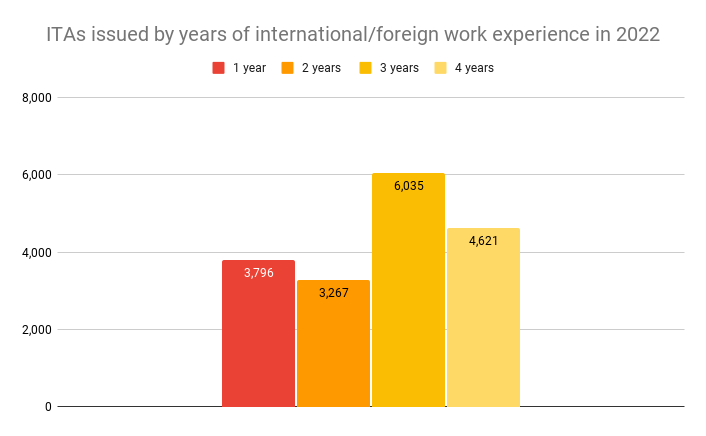
ITAs issued by years of international/foreign work experience in 2022
Foreign Work Experience: 35% of ITAs went to candidates with 5 or more years of foreign work experience. Surprisingly, 27% of ITAs were given to those with one year or less of foreign work experience.
Additional Points and Primary Occupations
Additional points played a crucial role in ITAs in 2022:
- Additional Points: Education in Canada (19,587 ITAs) and Arranged Employment (8,756 ITAs) were the most common additional point types. Women led in meeting criteria for French language proficiency points (53%).
- Primary Occupations: Technology-related occupations dominated, including software engineers, information systems specialists, and computer systems developers. Food service supervisors and cooks were also prevalent.
Changes in ITA Trends
- ITA Trends: There was a shift from TEER 2 occupations to TEER 1 occupations (those requiring a university degree). Technological fields saw the most significant rise in ITAs.
- Arranged Employment Points: Software engineers and designers replaced food service supervisors as the most common occupation for candidates assigned Arranged Employment points in 2022.
In 2022, Express Entry ITAs were influenced by high language proficiency, diverse work experiences, additional points, and a significant shift toward technology-related occupations. Understanding these trends is crucial for prospective applicants in the Express Entry system.
Global Origins of ITA Recipients
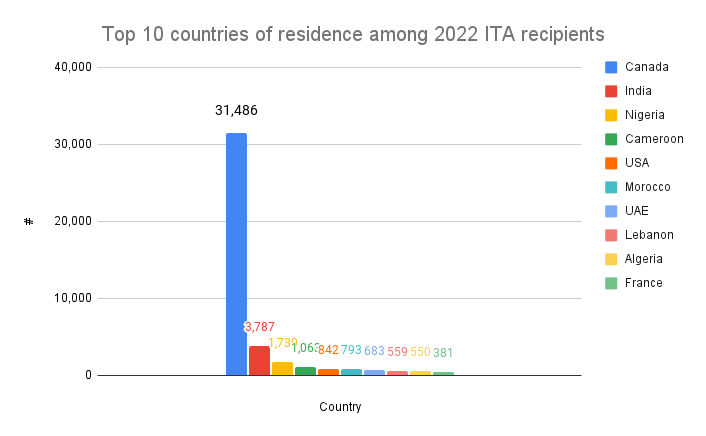
In 2022, most Invitations to Apply (ITAs) were granted to candidates residing in Canada (31,486), India (3,787), and Nigeria (1,730). This mirrors the trend from 2021, indicating a consistent pattern in recipient nationalities.
The complete list of the top 10 countries of residence among 2022 ITA recipients is as follows (the number of ITAs issued to residents of each country is in parentheses).
- Canada (31,486)
- India (3,787)
- Nigeria (1,730)
- Cameroon (1,063)
- United States of America (842)
- Morocco (793)
- United Arab Emirates (683)
- Lebanon (559)
- Algeria (550)
- France (381)
Similar to the above data, below is the complete list of the top 10 countries of citizenship among ITA recipients in 2022. Listed next to each country, in parentheses, is the number of ITAs their citizens were issued this past year.
- India (20,769)
- Algeria (2,909)
- People’s Republic of China (2,456)
- Cameroon (1,218)
- Iran (1,210)
- France (1,069)
- Morocco (978)
- United States of America (939)
- Philippines (934)
- Pakistan (923)
Among ITA recipients, Indians (20,769), Algerians (2,909), and Chinese citizens (2,456) received the most ITAs. India has consistently held the top spot for the last three years.
Preferred Canadian Provinces
Ontario remained the most popular province for Express Entry applicants, with 48% settling there, a decrease from 61% in 2021. British Columbia (20%) and Alberta (12%) were the next favored destinations.
Note: Quebec-bound Express Entry applicants are not accounted for in this data, as the province operates its own distinct immigration programs
Application Processing Times
Application processing times increased significantly in 2022, with the total processing time rising to 21 months from 8 months in 2021. Notably, the processing time for Federal Skilled Trades Program (FSTP) applications increased dramatically from 23 months (in 2021) to 63 months in 2022.
Conclusion:
Despite a 59% decrease in ITAs from the previous year, Express Entry remained a vital immigration pathway for Canada. The system adapted in 2022, focusing on specific employment needs through category-based draws, targeting areas with significant gaps such as healthcare, STEM, transport, trades, and agriculture. With 11,900 ITAs issued in 2023 through these categories, Canada continued to attract skilled professionals globally. The future holds further enhancements to the Express Entry system, ensuring that Canada continues to benefit from a talented global workforce while offering immigrants one of the world’s best destinations.
Our expert immigration consultants are here to guide you through the Express Entry process and ensure a seamless and successful journey to permanent residency in Canada! You can speak with one of our consultants by clicking the button below.

Sep 28, 2023 | Blog, Express Entry, Immigration, In the News, Permanent Residency, Why you need an immigration specialist
Recent Canada Express Entry draw
In the most recent draw held on September 28, the IRCC (Immigration, Refugees and Citizenship Canada) issued 600 invitations to apply to eligible candidates.
This targeted category-based Express Entry draw focused for the first time on agriculture and agri-food occupations, with a minimum Comprehensive Ranking System (CRS) score of 354.
Understanding Express Entry
Express Entry is an innovative application management system that oversees the Federal Skilled Worker Program, the Canadian Experience Class, and the Federal Skilled Trades Program. Candidates in the Express Entry pool are assessed based on various factors like work experience, language ability, education, and age. They are assigned a Comprehensive Ranking System score, and those with the highest scores are most likely to receive an ITA.
New Category-Based Selection Criteria
Since May 31, IRCC introduced new category-based selection criteria, focusing on specific attributes rather than just a high CRS score. The six new categories for Express Entry candidates are:
- Healthcare
- Science, technology, engineering, and mathematics (STEM) professions
- Trades, such as carpenters, plumbers, and contractors
- Transport
- Agriculture and agri-food
- Strong French-language proficiency
Benefits of Express Entry
Moreover, Express Entry has revolutionized how Canada selects its immigrants, prioritizing those who bring valuable skills and experience to the country. With unparalleled efficiency, this program processes applications at lightning speed, providing applicants with the opportunity to settle in Canada quickly and effectively.
Eligibility and Requirements
To succeed in Express Entry, meeting certain requirements is paramount. Your work experience, education, language proficiency, and other factors will determine your score in the Comprehensive Ranking System (CRS). Keep your documents in order and strive to reach the minimum required score to receive an invitation.
Tips to Increase Your Chances
Want to enhance your chances of receiving an ITA in future draws? Here are some tips to boost your Express Entry profile:
- Improve Language Skills: Dedicate time to enhancing your language proficiency in English or French. Higher language scores can significantly improve your CRS score.
- Job Offer Advantage: Having a valid job offer from a Canadian employer can increase your CRS score and chances of receiving an ITA.
- Maximize Education: Pursue higher education to gain additional points in the CRS system and stand out in future draws.
- Stay Informed: Stay updated with the latest Express Entry draws and changes to the selection criteria.
- Professional Guidance: Furthermore seek assistance from experienced immigration consultants to navigate the Express Entry process smoothly and optimize your profile.
How can we help you?
When you receive an ITA (Invitation to Apply), a new series of steps begins for you to obtain your permanent residency in Canada.
Get in touch with us as soon as possible to get access to our Post-ITA (post invitation to apply) services.
Do you want to do it yourself? Find out more about how to get an ITA and what to do next – Quick Guide.
Our expert immigration consultants are here to guide you through the Express Entry process and ensure a seamless and successful journey to permanent residency in Canada! You can speak with one of our consultants by clicking the button below.

Sep 18, 2023 | Blog, Express Entry, Federal Skilled Trades, Immigrate to Canada, Immigration, In the News, New Immigration Programs, New Laws, Provincial Nominee Program, Skilled Workers, Temporary Foreign Workers, Work Permits, Working In Canada
Canada launches new Express Entry for transport workers under a new category-based selection process to invite skilled newcomers with work experience in the transport sector to apply for permanent residence. This includes occupations such as commercial truck drivers, pilots, and aircraft assembly workers.
The IRCC announced that the first round of invitations for transport occupations through category-based selection in Express Entry will occur this week.
The new process will help to address labour shortages in the transport sector and support Canada’s economic growth. Category-based selection will allow Canada to invite candidates with the specific skills and experience that are needed to fill key positions.
Canada’s Express Entry system is now tailored to provide a streamlined and efficient pathway for individuals with expertise in critical fields. By prioritizing the invitation of skilled newcomers with work experience in transport occupations, Canada aims to meet the increasing demand for talent and fill key positions that contribute to the nation’s economic growth and advancement.
Category-based selection rounds will continue throughout the year, alongside general and program-specific invitation rounds.
Quotes:
“As Canada grows its economy, we’re committed to improving transport and infrastructure to ensure the safe and efficient movement of goods and passengers across the country. Category-based selection helps us invite newcomers with experience in transport occupations to fill significant labour gaps and ensure the future success of the Canadian transport sector. I look forward to welcoming more skilled workers to our country, as their knowledge and expertise are invaluable, to meet our labour market needs.”
– Marc Miller, Minister of Immigration, Refugees and Citizenship
“The transportation sector is crucial to our economy, and if we want to keep things moving, we need to invest in the people that move travellers and transport our goods. With this new initiative, we are helping address a critical skills shortage while also attracting new, talented people to communities across Canada. Truck drivers, pilots, aviation mechanical engineers and seafarers play a critical role in our economy and Canadians’ lives. Filling vacancies in these professions will boost economic growth and create stronger and more resilient supply chains.”
– Pablo Rodriguez, Minister of Transport
Quick facts:
- Express Entry is Canada’s flagship application management system for those seeking to immigrate permanently through the Federal Skilled Worker Program, the Canadian Experience Class, the Federal Skilled Trades Program, and a portion of the Provincial Nominee Program.
- In June 2022, the Government of Canada made changes to the Immigration and Refugee Protection Act to allow for the selection of immigrants based on key attributes that support economic priorities, such as specific work experience or knowledge of French.
- On May 31, 2023, the Honourable Sean Fraser, former Minister of Immigration, Refugees and Citizenship, announced the launch of category-based selection, a new process to welcome skilled newcomers with work experience in priority jobs as permanent residents.
- The categories were determined following extensive consultations with provincial and territorial partners, stakeholders, and the public, as well as a review of labour market needs. A complete list of eligible jobs for the new categories is available on the Canada.ca website.
(more…)

Sep 6, 2023 | Blog, Immigration, In the News, New Immigration Programs, New Laws, Student Visas
Canada is a popular destination for international students, with over 600,000 foreign students enrolled in the country each year. However, Canada’s international student program has been criticized for its lack of transparency and oversight. In response to these concerns, the Canadian government launched the Trusted Institutions Framework (TIF) in 2023.
Canada Trusted Institutions Framework requirements
The TIF sets out a clear set of standards for institutions that want to be designated as “trusted institutions.” These standards cover three key areas:
- Compliance with Canadian laws and regulations: Institutions must have a history of complying with all applicable Canadian laws and regulations, including those governing immigration, education, and labour.
- Quality educational offering: Institutions must provide a quality educational offering that meets the standards of Canadian post-secondary education. This includes having qualified faculty, providing a rigorous curriculum, and offering a safe and supportive learning environment.
- Commitment to the safety and well-being of international students: Institutions must have a commitment to the safety and well-being of their international students. This includes providing support services such as counseling, translation, and immigration advice.
In addition to the three key requirements mentioned above, the TIF also includes a number of other provisions, such as:
- A requirement for institutions to have a risk management plan in place to address potential issues such as fraud and exploitation.
- A requirement for institutions to provide regular updates to the government on their compliance with the TIF.
- A mechanism for the government to revoke the designation of an institution that fails to meet the requirements of the TIF.
According to IRCC, “Given that these discussions are ongoing, IRCC cannot speculate on future policy decisions. However, any new developments would be communicated publicly.”
DLIs will be tasked with sharing additional data, including retention rates, on-time program completion, revenue from international tuitions, support services expenditure, housing availability, and teacher-student ratios.
Measuring Institutional Performance under the TIF
The Trusted Institutions Framework (TIF) will evaluate the performance of Designated Learning Institutions (DLIs) based on a number of key indicators, including:
- Retention rate: The percentage of international students enrolled in multi-year study programs who choose to continue their studies at the same institution after their first year in Canada.
- On-time program completion rate: The percentage of international students who complete their programs within the advertised length of study.
- Revenue from international tuition: The percentage of a DLI’s total tuition revenue that is derived from international student tuition fees.
- Scholarships for less developed countries: The dollar value and the percentage of total scholarships and grants awarded to international students from countries identified on the United Nations Least Developed Countries list.
- Funding for international student support: The value of dedicated support services provided to international students per student and as a percentage of average international student tuition.
- DLI-administered housing availability: The total number and percentage of international students who are accommodated in housing administered by their respective institutions.
- Teacher-student ratio: The average teacher-student ratio for the ten courses with the highest enrollment of international students.
These indicators will be used to assess the effectiveness and commitment of DLIs to providing a high-quality education and support services to international students.
Benefits of the Trusted Institutions Framework
Institutions that meet these requirements will benefit from a number of advantages, including:
- Priority access to Canadian immigration programs
- Recognition of their commitment to excellence
- Improved reputation
The TIF is still a new initiative, but it has the potential to make a significant difference in the lives of international students in Canada. By ensuring that institutions are held accountable to high standards, the TIF can help to create a more welcoming and supportive environment for international students.
Conclusion
The TIF is a significant step forward in improving the quality and safety of Canada’s international student program. By establishing clear standards for institutions and holding them accountable to those standards, the TIF can help to ensure that international students have a positive experience in Canada.
(more…)

Aug 15, 2023 | Blog, Express Entry, Immigration, In the News, Permanent Residency, Why you need an immigration specialist
Recent Canada Express Entry draw
In the most recent draw held on August 15, the IRCC (Immigration, Refugees and Citizenship Canada) issued 4,300 invitations to apply to eligible candidates.
This targeted all-program Express Entry draw, with a minimum Comprehensive Ranking System (CRS) score of 496.
Understanding Express Entry
Express Entry is an innovative application management system that oversees the Federal Skilled Worker Program, the Canadian Experience Class, and the Federal Skilled Trades Program. Candidates in the Express Entry pool are assessed based on various factors like work experience, language ability, education, and age. They are assigned a Comprehensive Ranking System score, and those with the highest scores are most likely to receive an ITA.
Benefits of Express Entry
Moreover, Express Entry has revolutionized how Canada selects its immigrants, prioritizing those who bring valuable skills and experience to the country. With unparalleled efficiency, this program processes applications at lightning speed, providing applicants with the opportunity to settle in Canada quickly and effectively.
Eligibility and Requirements
To succeed in Express Entry, meeting certain requirements is paramount. Your work experience, education, language proficiency, and other factors will determine your score in the Comprehensive Ranking System (CRS). Keep your documents in order and strive to reach the minimum required score to receive an invitation.
Tips to Increase Your Chances
Want to enhance your chances of receiving an ITA in future draws? Here are some tips to boost your Express Entry profile:
- Improve Language Skills: Dedicate time to enhancing your language proficiency in English or French. Higher language scores can significantly improve your CRS score.
- Job Offer Advantage: Having a valid job offer from a Canadian employer can increase your CRS score and chances of receiving an ITA.
- Maximize Education: Pursue higher education to gain additional points in the CRS system and stand out in future draws.
- Stay Informed: Stay updated with the latest Express Entry draws and changes to the selection criteria.
- Professional Guidance: Furthermore seek assistance from experienced immigration consultants to navigate the Express Entry process smoothly and optimize your profile.
How can we help you?
When you receive an ITA (Invitation to Apply), a new series of steps begins for you to obtain your permanent residency in Canada.
Get in touch with us as soon as possible to get access to our Post-ITA (post invitation to apply) services.
Do you want to do it yourself? Find out more about how to get an ITA and what to do next – Quick Guide.
Our expert immigration consultants are here to guide you through the Express Entry process and ensure a seamless and successful journey to permanent residency in Canada! You can speak with one of our consultants by clicking the button below.

Aug 9, 2023 | Blog, Canadian Employers, Immigration, In the News, New Immigration Programs, New Laws, Skilled Workers, Temporary Foreign Workers, Working In Canada
In a move aimed at simplifying the process of hiring temporary foreign workers, the Canadian federal government is introducing the “Recognized Employer Pilot” program. This initiative seeks to reduce bureaucratic hurdles for employers and provide a streamlined path for bringing in foreign workers. However, as this program unfolds, experts and advocates are raising important questions about the program’s scrutiny measures, potential economic implications, and its impact on Canadian society.
The Recognized Employer Pilot: A Breakdown
Streamlining the Hiring Process
The Recognized Employer Pilot program, set to launch in September, is poised to revolutionize the way Canadian employers engage temporary foreign workers. Initially targeting the agriculture sector, the program will later extend to all industries in January. Eligible employers with a strong history of compliance with program requirements will receive a three-year permit to bring in foreign workers without the need for frequent reapplications.
“The Recognized Employer Pilot will cut red tape for eligible employers, who demonstrate the highest level of protection for workers, and make it easier for them to access the labour they need to fill jobs that are essential to Canada’s economy and doof security”
Addressing Concerns and Enhancing Protections
However, with this shift comes valid concerns about the level of scrutiny these workers will receive and the economic landscape they will enter. As Canada grapples with challenges such as housing affordability, rising interest rates, and high inflation, critics are urging a closer look at the conditions foreign workers will face.
The Current Scenario: Temporary Foreign Worker Program
Presently, employers must undergo a labor market impact assessment (LMIA) each time they hire foreign workers under the Temporary Foreign Worker Program. This assessment ensures that a genuine need exists for filling the position. In recent years, the number of approved temporary foreign worker positions has surged, from approximately 89,000 in 2015 to over 221,000 in the last year. This doesn’t account for international students, graduates with open-work permits, and mobility agreements with various countries.
The Shift Towards Recognized Employers
The Recognized Employer Pilot promises to alleviate administrative burdens for qualified employers. These are employers who can demonstrate a robust commitment to worker protection. The program aims to simplify labor access for vital roles within Canada’s economy and food security. Employment Minister Randy Boissonnault highlights the program’s budget of $29.3 million over three years and asserts that the application process will be rigorous, targeting employers with exemplary recruitment practices.
Balancing Opportunity with Responsibility
Worker Protections and Social Impact
The growing reliance on foreign workers, though addressing labor shortages, is not without its challenges. Workers in low-skill, low-wage positions have reported abuses and exploitation by employers. Critics argue that without thorough oversight, such abuses could continue to persist, even within the trusted employer framework. The flexible labor force facilitated by these initiatives may strain housing markets, healthcare accessibility, and education systems.
Syed Hussan, executive director of Migrant Workers Alliance for Change, emphasizes that the effectiveness of the Recognized Employer Pilot hinges on the scrutiny of employers. He raises concerns about workers’ reluctance to complain due to potential reprisals. While the government has taken steps to protect migrant workers, further vigilance is necessary to ensure their rights and well-being.
Conclusion: Toward a Balanced Approach
In a bid to bolster Canada’s workforce and ensure essential services, the Recognized Employer Pilot program offers a unique pathway for employers to hire temporary foreign workers. While this move is promising, it also calls for a careful balance between streamlining processes and safeguarding worker rights. The success of this program lies in the implementation of stringent scrutiny measures and ongoing efforts to protect the well-being of all workers involved.
(more…)

 Useful Resources for Canada
 Useful Resources for U.S.
 Our Local Immigration Services


