“Should I apply for a work permit or a student permit? Is there a better option for me? Which path should I follow?”. We receive this type of question all the time and, to be honest, there is not a straight answer as a number of factors go into this decision. However, you can use these three questions to help you decide.
By having realistic expectations, you can work efficiently towards your immigration goals. So let’s dive right into it!
Q1: What is my English proficiency? Is it important to work or study in Canada?
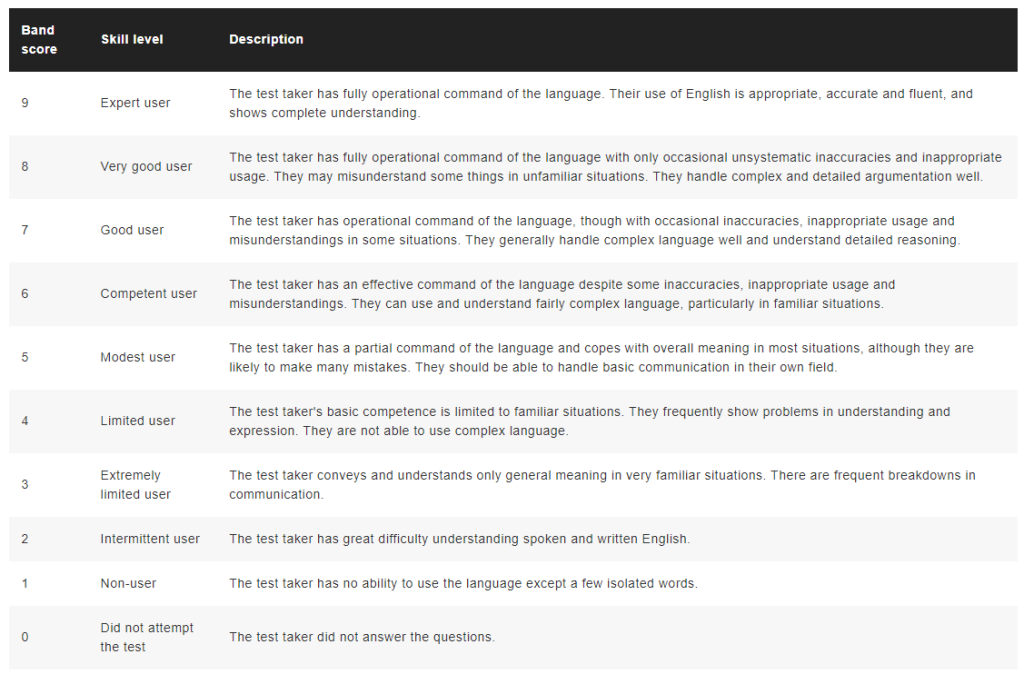
This is key to determining the program you can apply to. On one hand, if you have a beginning level of English, perhaps the best and only option is to start a study program before thinking about working. On the other hand, if your proficiency is higher (certified by a standardized test such as IELTS) you can consider other immigration options, like the Provincial Nominee Program.
The IELTS scale (1)
Q2: How much money can I invest? Studying and working are compatible?
Immigrating always involves a considerable cost. However, determining how much you’re willing to invest can make or break your immigration options.
For example, you must consider the annual cost of living in the city or province you wish to live in, the average salary for your desired job, and how long it will take for you to recoup your investment.
In addition, there are other factors to look at such as working while studying, the number of hours you are allowed to work, the industry you are planning to work in, etc.
Check out the cost of living of the most popular cities ranked from lower to higher cost of living.
Maybe you initially planned on working in Canada, but you do not qualify for any program. Don’t let that discourage you! After all, there are several pathways to immigrating to Canada; each step counts toward achieving your ultimate goal.
Changes to the National Occupational Classification (NOC) and how they affect Express Entry applicants
A number of changes have been made to the National Occupational Classification (NOC) system recently, which have an impact on how your work experience must be listed in your Express Entry profile and eligibility for some permanent residence (PR) candidates.
The Canadian immigration application process can become confusing and stressful if eligibility criteria or the way information is entered are changed.
This shift in eligibility criteria will affect 100+ immigration programs in Canada, including the Express Entry program.
What is the NOC? How does it work?
The National Occupational Classification (NOC) is the national reference for occupations in Canada. It provides a systematic classification structure that categorizes the entire range of occupational activity in Canada. This works for collecting, analyzing, and disseminating occupational data for labor market information and employment-related program administration.
In addition, occupational information is critical for the provision of the labor market and career intelligence, skills development, occupational forecasting, labor supply and demand analysis, employment equity, and numerous other programs and services.
What changes are being made under NOC 2021?
From November 16, 2022, changes to the National Occupational Classification (NOC) had been made to replace the NOC 2016. This represents an introduction to new terminology and a revised classification structure for occupations. Here are the three significant changes being made under NOC 2021:
NOC 2021 accounts for the differences between educational requirements and formal training, and consequently, the new classification reflects the knowledge and skills gained through on-the-job work experience.
NOC 2021 replaces the former four-category “Skill Level” structure with six TEER levels, from TEER 0 to 5. TEER levels represent the Training, Education, Experience, and Responsibilities for each occupation, with TEER 0 having the highest requirements and TEER 5 the lowest. The table below describes TEER levels and explains how they differ from Skill Levels under NOC 2016:
TEER
Requirements
How it differs from NOC 2016 Skill Levels
TEER 0
Management
Management was classified as Skill Type 0.
TEER 1
University degree (bachelor’s, master’s or doctorate); OR
Previous experience and subject matter expertise in a related TEER 2 occupation.
Skill Level A required a university degree but did not account for prior experience or expertise in related occupations.
TEER 2
Completion of a two- to three-year post-secondary program (diploma or certificate) at community college, institute of technology or CÉGEP; OR
Completion of a two- to five-year apprenticeship training program; OROccupations with supervisory or safety responsibilities (e.g. police officers and firefighters); ORSeveral years of experience in a related TEER 3 occupation.
The requirements under Skill Level B have been split into TEER 2 and 3.
The TEER levels also account for prior experience in related occupations, which was not considered eligible under Skill Level B.
TEER 3
Completion of a post-secondary college program shorter than two years (diploma or certificate); OR
Completion of an apprenticeship training program of under two years; OROver six months of on-the-job training, training courses or specific experience in addition to some secondary (school) education; ORSeveral years of experience in a related TEER 4 occupation.
The requirements under Skill Level B have been split into TEER 2 and 3.
The TEER levels also account for prior experience in related occupations, which was not considered eligible under Skill Level B.
TEER 4
Completion of secondary school; OR
Several weeks of on-the-job training with some secondary education; ORExperience in a related TEER 5 occupation.
Skill Level C included up to two years of on-the-job training with some secondary education, whereas under TEER 4, several weeks of on-the-job training is accepted.
TEER 4 also accounts for prior experience in related occupations.
TEER 5
Short work demonstration and no formal educational requirements.
Similar to Skill Level D.
Also, the new NOC 2021 has changed from a four to a five-digit coding system. Let’s use Advertising, marketing and public relations managers as an example to explain the NOC classification hierarchy. Under NOC 2016 its code was 0124; under NOC 2021 its code is 10022. Here we breakdown the differences between the two codes for Advertising, marketing and public relations managers:
Level
Details
Under NOC 2021 (10022)
Under NOC 2016 (0124)
Broad occupational category (first digit of code)
Business, finance and administration occupations (1)
1
0 (Management occupations)
Major group (TEER or Skill Level) (second digit of code)
TEER 0 – Management (0)
10
01 (Skill level A)
Sub-major group
Specialized middle management occupations in administrative services, financial and business services and communication except broadcasting (0)
100
N/A
Minor group
Managers in financial and business services (2)
1002
012 (Managers in financial and business services)
Unit group (or occupation)
Advertising, marketing and public relations managers (2)
10022
0124
This is how the skill type categories of the current NOC system match the TEER categories of the 2021 NOC system:
NOZ 2016
NOK 2021
Ability type 0
TAR 0
Skill level A
TEA 1
Skill Level B
TEA 2
Skill Level B
TEA 3
Skill level C
TEA 4
Skill level D
TEA 5
Updated NOC 2021 Eligibility Criteria for Express Entry
Eligibility Criteria
Canadian experience class
Federal skilled worker program
Federal handicraft programme
Knowledge of English or French
CLB 7 for TEER 0 or TEER 1 occupations; CLB 5 for TEER 2 or TEER 3 occupations
KLB 7
CLB 5 for speaking and listening; CLB 4 for reading and writing
Type/level of work experience
Canadian work experience in an occupation listed in one or more of these NOC TEER categories: TEER 0, TEER 1, TEER 2, or TEER 3.
Work experience in an occupation listed in one of these NOC TEER categories: TEER 0, TEER 1, TEER 2 or TEER 3.
Work experience in a trade in key groups of TEER 2 or TEER 3.*
Scope of work experience
One year in Canada in the last three years (either a combination of full-time or part-time work).
One consecutive year within the last 10 years (combination of part-time, full-time, or more than one full-time job).
Two years within the last five years (either combination of full-time or part-time employment)
job offer
Not required.
Not required, but you can earn Eligibility Criteria (FSW) points if you have a valid job offer.
A valid job offer for full-time employment for a cumulative period of at least one year, or a certificate of qualification in the craft issued by a Canadian provincial, territorial or federal agency.
education
Not required.
Secondary school diploma required. You can get more Eligibility Criteria Points (FSW) for your post-secondary education.
Do I need to update the NOC codes in my existing Express Entry profile?
If you have not yet received an ITA, you must update your Express Entry profile with new NOC information by November 16, 2022. Creating an Express Entry profile after November 16, 2022 means using the NOC 2021 classification. For those who have already received an ITA, you should continue your application using NOC 2016 codes. Therefore, when you fill out your PR application, use NOC 2016 codes for your past experiences.
How is your particular situation affected by this?
A candidate’s IRCC action requirements will vary according to where they are in their Express Entry journey. Therefore, the best course of action is to speak with a licensed consultant and analyze your situation together to find the best alternative for your case.
Contact us today! One of your licensed immigration consultants will be happy to help you.
The Canada Super Visa is also known as the Parents and Grandparents Super Visa. Under this permit, parents and grandparents of permanent residents and citizens can visit their relatives for up to 2 years at a time. So it is much better than a Standard Visitor Visa!
The general requirements are:
A letter of invitation from your son or grandson.
Proof that your child or grandchild meets the minimum family income requirements.
Proof of payment of Canadian health insurance, valid for at least 1 year from the entry date.
It is important to note that a letter of invitation does not guarantee that a visa will be issued. The visa offices only use this to determine whether the applicant satisfies the terms and requirements of Canadian immigration law.
Additionally, take into account that a number of other factors are taken into consideration by the officers, including the purpose of the visit, the stability of the home country’s economic and political systems, and their ties to that country.
Why is it better than a Standard Visitor Visa?
One of the biggest benefits of the Super Visa is that allows the person to enter Canada multiple times for up to 10 years. It is possible for individuals to stay in Canada for a maximum of two years at a time. In contrast, a 10-year multiple entry visa (Standard Visitor Visa) only has a six-month visit period for each entry into the country.
Canada’s Start-up Visa Program targets immigrant entrepreneurs with the skills and potential to build innovative businesses in Canada that can create jobs for Canadians and compete on a global scale.
There are many reasons why Canada is the best place to build your business as an entrepreneur. Canada’s advantages include:
A strong economy
Low taxes and low business costs
Excellence in research and innovation
High quality of life
In addition, there are more than 50 Canadian venture capital funds, angel investor groups, and business incubators designated to participate in the program.
Last but not least, entrepreneurs who participated in the program in the first 3 years received over $3.7 million in investment capital from designated entities to help them grow their businesses in Canada.
What are the requirements of this visa for entrepreneurs?
There are four requirements you need to meet to be eligible for a Canadian start-up visa:
Prove your business is supported by a designated organization
Meet ownership requirements: You must hold at least 10% of the voting rights attached to all shares of the company. Together with the designated organization, you must hold at least 50% of the voting rights attached to all shares of the company.
Meet the minimum language requirements (CLB 5 in all areas) in English or French; and
Show sufficient funds to settle in Canada.
Not sure if you qualify? Don’t know where to start?
If you are still in doubt that whether the Start-Up Visa Program in Canada is for you, take our free online assessment to determine your eligibility. .is super important
Or contact us today! One of your licensed immigration consultants will be happy to help you.
New Immigration Programs Pave Way for Health Care and Essential Workers
Exciting news! The Honourable Marco E. L. Mendicino on on April 14th, 2021 announced that there will be a focus on new pathways for temporary workers in healthcare, essential workers, and international graduates who are already residing in Canada.
“The pandemic has shone a bright light on the incredible contributions of newcomers. These new policies will help those with a temporary status to plan their future in Canada, play a key role in our economic recovery and help us build back better. Our message to them is simple: your status may be temporary, but your contributions are lasting—and we want you to stay.” Says Mendicino.
Effective May 6th 2021, Immigration, Refugees and Citizenship Canada (IRCC) will launch 6 new pathway streams for permanent residency for over 90,000 health care, essential workers and international graduates who have been actively contributing to Canada’s economy. Including the French-speaking temporary residents, these workers and graduates who are already in Canada possesses the skills and experienced needed to fight through the pandemic and to accelerate Canada’s economic recovery. These new streams will pave the way for thousands of new immigrants to receive Canadian permanent residence status.
IRCC will be accepting applications through the following 3 streams:
20,000 applications for temporary workers in health care
40,000 applications for international students who graduated from a Canadian institution
To be eligible for the three new streams announced, temporary workers must have at least one year of Canadian work experience in a health-care profession or in select essential occupations. International students must have completed an eligible Canadian post-secondary education within the last 4 years, no earlier than January 2017. All workers and graduates will need to meet the language proficiency of at least CLB 4 in English or French and the test results must be no less than two-year-old when application is received.
To promote Canada’s official languages, three additional streams with no application cap for healthcare workers, essential workers and international graduates who are French-speaking or bilingual in English and French. Candidates will need to meet the same requirements for the health-care, essential occupations and graduates in addition to French language proficiency of at least CLB 4 and the evaluation must be no less than two years old when the application is received.
The 6 new streams will remain open until November 5th, 2021, or until they have reached their application cap (not including the French-speaking or bilingual candidate applicants). The announcement of these new streams aims to help achieve Canada’s 2021 immigration Level’s plan, which is expected to welcome 401,000 new permanent residents. The plan will help create jobs and drive long-term growth in Canada. We have already seen the historical federal drawing which invited all 27,332 candidates in the Canadian-Experience Class Express Entry pool. Canada has welcomed over 50,000 new permanent residents thus far.
On Wednesday April 22, United States President Donald Trump signed the executive order to suspend immigration into the United States in hopes to prioritize the re-hiring of Americans displaced by the novel Coronavirus. The difference? Canada is still open to immigrants and accepting applications. The new U.S. immigration suspension will last for 60 days and will be reevaluated and extended if deemed necessary.
Foreign nationals who are outside of the United States and are seeking permanent residency (commonly called “green card”) will not be able to apply. It’s important to note that foreign nationals who are already in the United States are exempt from the suspension and will be able to adjust their status or extend their stay.
Children and spouses of U.S. citizens fall into the exemption of the suspension and may continue with their plans to submit their applications for a Green Card. Other foreign nationals such as temporary works in essential positions such as medical personnel, members of the Armed Forces and law enforcement, prospective adoptees are also exempt.
Canada remains wide open and accepting applications of all kinds
Immigration, Refugees and Citizenship Canada (IRCC) is not immune to the Coronavirus situation. However, they have not stopped accepting applications, despite the skeleton shift and reduced number of visa officers.
Applications can be submitted even if they are incomplete
While the Canadian immigration department has slowed down processing, foreign nationals who are considering applying for permanent residence may still submit their applications. Given that many required services are closed, such as the English testing centres (IELTS, CELPIP), credential evaluation services (WES, and several others), including biometrics centres around the world, Canada will accept incomplete applications. Applicants may submit their applications and will be allowed to submit the missing documentation at a later date.
Extend your status and remain in Canada longer
Individuals who are currently in Canada and wish to apply for an extension of their visitor status, work permit or study permit may do so, and may remain in Canada on “implied status” until a decision is made on the application to extend their stay.
Pause on the processing of non-essential visitor visa applications
To combat processing delays on essential applications such as family reunification, some urgent work permit applications and extensions, Canada has announced that they will not process visitor visa applications for non-essential travel.
Do you need help to stay in Canada? Are you planning to submit your application for permanent residence or family immigration application?
Our skilled and professional team of immigration consultants are here to assist you overcome the hurdle during this uncertain time. Our immigration representatives are up-to-date in all aspects of immigration, including the unprecedented situation surrounding COVID-19 and can help you navigate through the system properly.
We are here for you. Call us today 416-665-3939 or 1-888-808-7338.





 Useful Resources for Canada
 Useful Resources for U.S.
 Our Local Immigration Services


