“Should I apply for a work permit or a student permit? Is there a better option for me? Which path should I follow?”. We receive this type of question all the time and, to be honest, there is not a straight answer as a number of factors go into this decision. However, you can use these three questions to help you decide.
By having realistic expectations, you can work efficiently towards your immigration goals. So let’s dive right into it!
Q1: What is my English proficiency? Is it important to work or study in Canada?
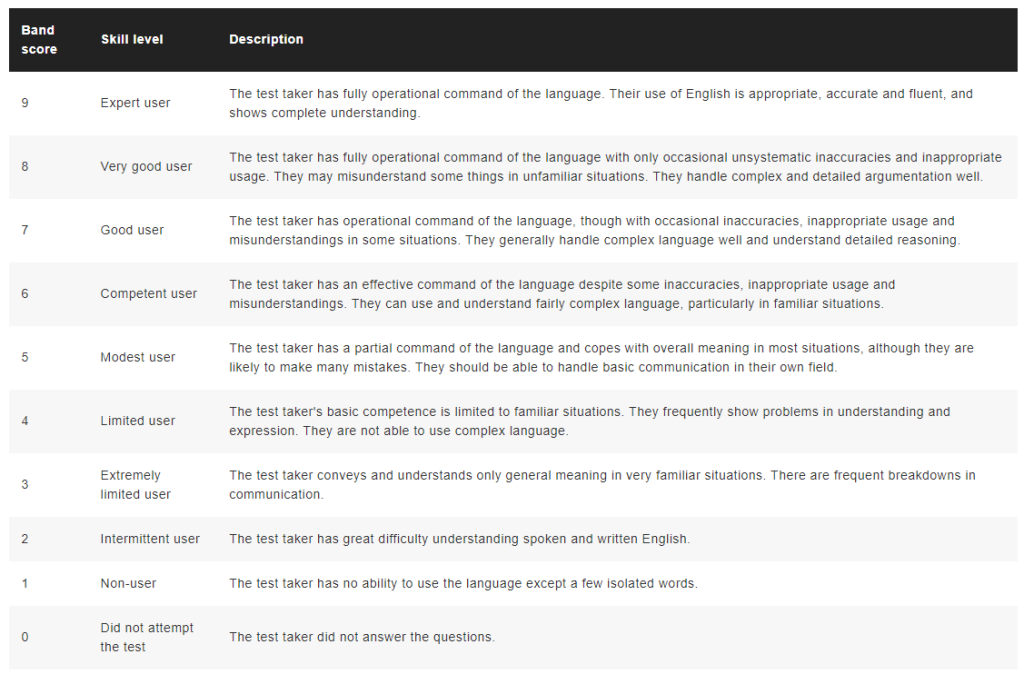
This is key to determining the program you can apply to. On one hand, if you have a beginning level of English, perhaps the best and only option is to start a study program before thinking about working. On the other hand, if your proficiency is higher (certified by a standardized test such as IELTS) you can consider other immigration options, like the Provincial Nominee Program.
The IELTS scale (1)
Q2: How much money can I invest? Studying and working are compatible?
Immigrating always involves a considerable cost. However, determining how much you’re willing to invest can make or break your immigration options.
For example, you must consider the annual cost of living in the city or province you wish to live in, the average salary for your desired job, and how long it will take for you to recoup your investment.
In addition, there are other factors to look at such as working while studying, the number of hours you are allowed to work, the industry you are planning to work in, etc.
Check out the cost of living of the most popular cities ranked from lower to higher cost of living.
Maybe you initially planned on working in Canada, but you do not qualify for any program. Don’t let that discourage you! After all, there are several pathways to immigrating to Canada; each step counts toward achieving your ultimate goal.
The Canada Super Visa is also known as the Parents and Grandparents Super Visa. Under this permit, parents and grandparents of permanent residents and citizens can visit their relatives for up to 2 years at a time. So it is much better than a Standard Visitor Visa!
The general requirements are:
A letter of invitation from your son or grandson.
Proof that your child or grandchild meets the minimum family income requirements.
Proof of payment of Canadian health insurance, valid for at least 1 year from the entry date.
It is important to note that a letter of invitation does not guarantee that a visa will be issued. The visa offices only use this to determine whether the applicant satisfies the terms and requirements of Canadian immigration law.
Additionally, take into account that a number of other factors are taken into consideration by the officers, including the purpose of the visit, the stability of the home country’s economic and political systems, and their ties to that country.
Why is it better than a Standard Visitor Visa?
One of the biggest benefits of the Super Visa is that allows the person to enter Canada multiple times for up to 10 years. It is possible for individuals to stay in Canada for a maximum of two years at a time. In contrast, a 10-year multiple entry visa (Standard Visitor Visa) only has a six-month visit period for each entry into the country.
The Start-Up Visa Program, which was launched in April 2013, invites immigrant entrepreneurs to bring their business to Canada. The program allows entrepreneurs to obtain permanent residence for themselves and their family. This pilot program was aimed at attracting pioneering foreign entrepreneurs who would contribute to the Canadian economy. After evaluation of the pilot, it has been determined that the Start-Up Visa Program is delivering on its goals to bring innovative companies into Canada, which in turn creates more jobs for middle-class Canadian workers in a range of industries. With the success of the pilot, the government has announced that it will make the Start-Up Visa Program a permanent part of the immigration landscape for 2018.
As of July 15, 117 principal applicants have received permanent residence through the Start-Up Visa Program. This represents 68 start-ups that were launched in Canada as a result of this program. At present, there are more than 50 Canadian venture capital funds, angel investor groups, and business incubators designated to participate in the program. Entrepreneurs who participated in the program in the first 3 years received over $3.7 million in investment capital from designated entities to help them grow their business in Canada.
Innovative entrepreneurs who wish to apply for permanent residence through the Start-Up Visa Program must meet the following minimum eligibility requirements.
Prove your business is supported by a designated organization;
Show your business meets ownership requirements;
Meet the minimum language requirements (CLB 5 in all areas) in English or French; and
Show sufficient funds to settle in Canada;
If you have an innovative business idea, you may be able to bring this idea with you to Canada. Take our free online assessment to determine your eligibility or contact us today to speak with a licensed immigration consultant.
There are many reasons why a person would choose to immigrate to Canada. Some people immigrate in hopes of living a better life and/or to give their children opportunities that may not be so readily available in their country. Some people immigrate because they live in a war-torn country and they fear for their safety and that of their family. Others have family already in Canada and they want to be close to them. Some people choose to immigrate to Canada with their spouse or partner. This process is called Spousal Sponsorship. Then there are those who come to Canada to gain valuable education and/or work experience.
When it comes to quality of life, Canada has most other countries beat. In fact, Canada was ranked #2 best country in the world and #1 in education. Just to compare, the US was ranked 7th best country and 7th in education. Canadians are also “the 6th happiest people in the world, while Americans lag behind at 13th.” And there is a reason why Canadians are so happy. They have universal healthcare, for one. And, relative to other countries, Canada has easier access to education / cheaper degrees, higher press freedom, higher economic freedom, and better prison and justice systems. Canadians also live longer, work less hours, take more days off, and earn more money than Americans. Wow. It’s true. The American dream has moved north.
Let’s talk about immigration policy. The main issue to consider here is that Canadian provinces, unlike US states, have the ability to set immigration policy. Immigration in Canada is a joint effort between the federal and provincial governments. Canada has a program called the Provincial Nominee Program (PNP), which allows provinces to choose who they bring in based on economic need. The PNP helps individuals and their families to apply for permanent residence based on set criteria developed by the individual provinces. This is good both for the immigrant, whose application for PR is fast-tracked by a provincial nomination, and for the province, as they are able to bring in workers to meet labor market demand. While many of Canada’s immigration programs focus on skilled worker immigration, the PNP allows provinces to select workers in any occupation, including low or no-skilled occupations, to meet the labor demands of the province. So, if you find yourself to not be eligible for any other economic immigration program, you may find success in one of the Provincial Nominee Programs.
Overall, Canada’s immigration policy is far superior to that of the United States. Canada welcomes immigrants based on merit, which means that individuals who receive permanent residence in Canada are typically well educated and highly skilled. Immigration to Canada is also easier and faster than US immigration for many people. So, if you are a young professional looking for better opportunities in a beautiful country, Canada might just be the best place to go. Or if you are a businessman or woman looking to expand your business or set up a new business, Canada is a great place to do this. Whatever your reasons are, our team of qualified immigration consultants can assist you with all of your immigration needs. To start, take our free online assessment and find out if you qualify for one of Canada’s many immigration programs. If you have any immigration questions, contact us for a consultation today.
Last week, the province of Ontario announced that it would welcome individuals with skilled work experience in a targeted Information and Communications Technology (ICT) occupation. Now, they have released a list of the targeted occupations.
Candidates will be selected from the Express Entry pool as part of the Human Capital Priorities (HCP) stream of the Ontario Immigrant Nominee Program. Candidates with work experience in one of the targeted ICT occupations may be eligible to receive Notifications of Interest (NOI) from the province of Ontario, even with a Comprehensive Ranking System (CRS) score of less than 400. Typically, under this program, candidates are required to have a CRS score of at least 400 in order to receive an NOI, which is an invitation to apply for a provincial nomination. Those who receive a provincial nomination also get an additional 600 CRS points and will likely receive an Invitation to Apply (ITA) for permanent residence in the next Express Entry draw.
The following list of occupations was released by the province of Ontario:
NOC 0131: Telecommunication Carriers Managers
NOC 0213: Computer and Information Systems Managers
NOC 2133: Electrical and Electronics Engineers
NOC 2147: Computer Engineers (Except Software Engineers and Designers)
NOC 2171: Information Systems Analysts and Consultants
NOC 2172: Database Analysts and Data Administrators
NOC 2173: Software Engineers and Designers
NOC 2174: Computer Programmers and Interactive Media Developers
NOC 2175: Web Designers and Developers
NOC 2241: Electrical and Electronics Engineering Technologists and Technicians
NOC 2281: Computer Network Technicians
NOC 2282: User Support Technicians
NOC 2283: Systems Testing Technicians
NOC 5224: Broadcast Technicians
NOC 5241: Graphic Designers and Illustrators
If your work experience does not fit in one of those listed occupations, you may still be eligible to apply for a provincial nomination under the Human Capital Priorities stream of the Ontario Immigrant Nominee Program. However, you will be required to have at least 400 CRS points and meet the requirements of the program.
Whether or not you fall under one of the targeted occupations, the first step towards obtaining a provincial nomination through the HCP stream is to create an Express Entry profile. Individuals who are interested in immigrating to and settling in the province of Ontario should contact us to discuss your options. We can help you prepare your online Express Entry profile as well as preparing your permanent residence application, in the event that you have already received an invitation to apply. Take our free online assessment to see if you qualify to apply for permanent residence through the Express Entry system.